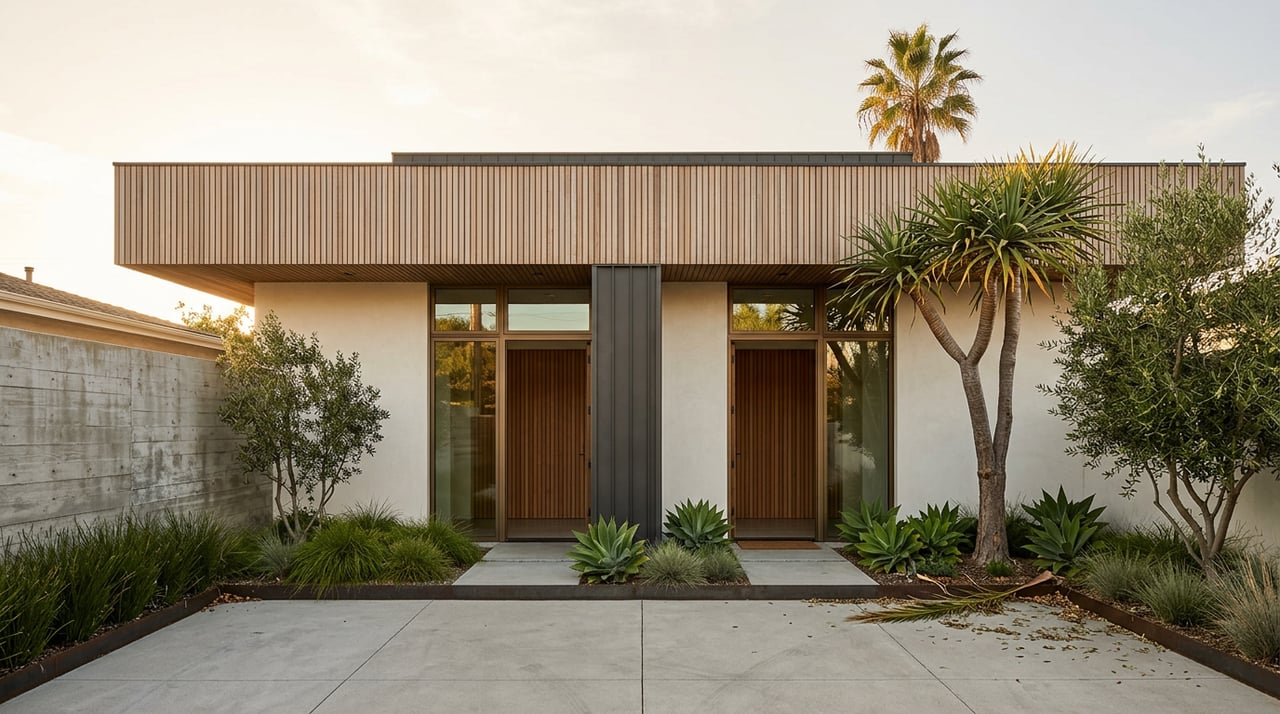
Why Two Identical Santa Monica Fourplexes Almost Never Sell for the Same Price
Picture two fourplexes on the same block in Santa Monica's Mid-City, same square footage, same lot size, same year of construction. One closes escrow at full asking price to a buyer who plans to live in one unit and rent the rest. The other sits on the market for months, then sells to an investor at a price that looks nothing like its twin. Nothing about the buildings explains the gap. The explanation sits in a filing cabinet: the building's rent-control status.
That status is the actual pricing mechanism behind most Santa Monica multi-unit sales, and it does something more complicated than most buyers and sellers assume. It does not just apply a flat discount to older buildings. It splits the market into two separate pricing systems that run on different logic, and the building with the deepest rent-control burden is often, counterintuitively, the one investors are willing to pay the most per dollar of income to own.
Santa Monica voters adopted the city's Rent Control Charter Amendment in April 1979, and the law covers certain residential rental units. That single cutoff catches most of the city's older duplexes, triplexes, and small apartment buildings. The difference matters the moment a buyer starts comparing a Santa Monica listing to a similar-looking building three blocks away in West LA.
According to the City of Santa Monica, once a building falls under Santa Monica's ordinance, every unit in it carries a Maximum Allowable Rent that increases only through the Rent Control Board's annual General Adjustment. The board set the 2026 adjustment at 2.6 percent, capped at $70 for units with a current allowable rent of $2,674 or higher, effective September 1, 2026. Owners also register annually at $240 per unit for the 2026-2027 fiscal year, half of which can be passed through to tenants as a $10 monthly charge.
None of that shows up in a listing photo. All of it shows up in the offer.
The instinct is to assume rent control just means a lower price, full stop. The reality splits into two separate calculations that pull in different directions.
Against a comparable vacant or owner-occupied building, a Santa Monica property with active rent-controlled tenants typically draws offers 15 to 25 percent lower. That gap exists because the buyer pool shrinks the moment a building carries sitting tenants at controlled rents. Owner-occupant buyers, who make up a large share of demand at the smaller end of the market, mostly disappear. What remains is an investor pool underwriting the property on a cap-rate or cash-flow basis rather than paying for the right to move in.
But inside that narrower investor pool, the pricing logic reverses. As of the first quarter of 2026, fully stabilized Santa Monica multifamily buildings, the ones already near market rent with little room to grow, were trading at cap rates between 5.25 and 6.0 percent. Value-add buildings, the ones with the widest gap between current controlled rents and what those units could command on turnover, were trading tighter: 4.25 to 4.75 percent on current income. Both ranges had widened 75 to 100 basis points from where they sat in 2022, but the ordering stayed the same. A lower cap rate means a buyer is paying more per dollar of current income, and that is exactly what happens with the buildings carrying the biggest rent-control burden. The below-market rent isn't priced as a liability. It's priced as the return.
That is the part sellers and less experienced buyers tend to miss. The building most burdened by rent control is not the cheapest building in the investor pool. It's often the one drawing the tightest pricing, because the gap between today's rent roll and tomorrow's is where the entire investment thesis lives.
The clearest evidence of this split shows up when a single unit turns over. A vacant unit inside an otherwise tenanted Santa Monica building can add $150,000 to $400,000 to the final sale price compared to the same property fully occupied at controlled rents. That is not a rounding error. It's the market pricing in the difference between a building only investors can buy and a building owner-occupants can bid on too, even if just one unit changes hands.
Sellers who understand this sometimes time a sale around a lease expiration rather than listing the moment it's convenient. Buyers evaluating a Santa Monica multi-unit should ask not just what the current rent roll shows, but which units are vacant, month-to-month, or approaching turnover, because that detail moves the price more than almost any other line item.
The clearest recent example of how this plays out at scale is 901 Ocean Ave, a 28-unit coastal multifamily building along Santa Monica's Ocean Avenue corridor, built in 1961 and 1970 on a 15,011-square-foot double lot with 100 feet of frontage. CBRE arranged the sale through a court-supervised receivership overseen by the Los Angeles County Superior Court, and the marketing process generated 10 offers before the property sold to a private local investor for $23.46 million, with the buyer also assuming roughly $2.4 million in transaction-related obligations for total consideration near $26 million.
Ten competing offers on a receivership sale of an older, rent-controlled coastal building is not the behavior of a market avoiding rent control. It's the behavior of a market that has learned how to price it, and to compete hard for buildings where the gap between current and market rent still has room to run.
Some owners look at that gap and decide the better play is to exit the rental business entirely. Santa Monica's Ellis Act implementation is among the more expensive versions in the state.
Santa Monica's Ellis Act relocation rules require payments, with additional amounts in some cases.
For a 10-unit building with a typical mix of tenant types, relocation costs are a factor before the owner has spent a dollar on renovation or repositioning. Those costs belong in any underwriting model for a buyer considering an Ellis Act path, because they change the return math as much as the purchase price does.
The mechanism plays out differently depending on where in Santa Monica the building sits. Mid-City, roughly the stretch between Wilshire and Montana, offers the widest range of product and is where most of the value-add activity concentrates, particularly in 8- to 20-unit buildings where cap rates vary widely based on condition and rent roll. South of Pico has seen the sharpest correction of any submarket. Buildings that traded at sub-4 percent cap rates in 2022 are now available at 5 percent or better, which rewards buyers with a longer hold horizon rather than a quick flip. Ocean Park continues to draw owner-occupants and smaller investors, helped by beach proximity, though the building stock there tends to be older and often needs significant capital investment before it performs.
A buyer comparing a Mid-City eightplex to a South of Pico sixplex at the same headline price is not comparing two versions of the same deal. They're comparing two different points on the same curve, and the rent-control status of each building is doing most of the work in explaining why.
Does every unit in the building actually fall under Santa Monica's ordinance? Confirm the certificate of occupancy date and check the Maximum Allowable Rent for each unit through the city's rent control lookup tool before relying on a seller's rent roll summary.
Is a vacancy coming up, and does the timeline matter to my offer? A unit turning over in the next few months changes both what a lender will underwrite and what an owner-occupant buyer can realistically do with the property.
If I'm considering an Ellis Act exit, have I included relocation costs in my analysis? Include those costs in the return calculation.
Santa Monica's rent control system rewards buyers who read a building's actual regulatory status before they read its listing price. The certificate of occupancy date, the current rent roll against the Maximum Allowable Rent, and the vacancy calendar tell a more accurate story than any median price ever will.
If you're evaluating a Santa Monica acquisition and want a clear read on where a specific building sits in this pricing structure, Rajaa Chraibi High-End Estates can walk through the numbers with you directly. Request Private Access — call or WhatsApp Rajaa for a confidential consultation.
This article is general information, not legal, tax or financial advice. Consult a qualified professional about your situation.
No matter where you are in the buying or selling journey, we’re here to answer your questions and provide expert advice. Contact us today, and let’s make your next move a success.
High-End Estates | CA DRE# 0225